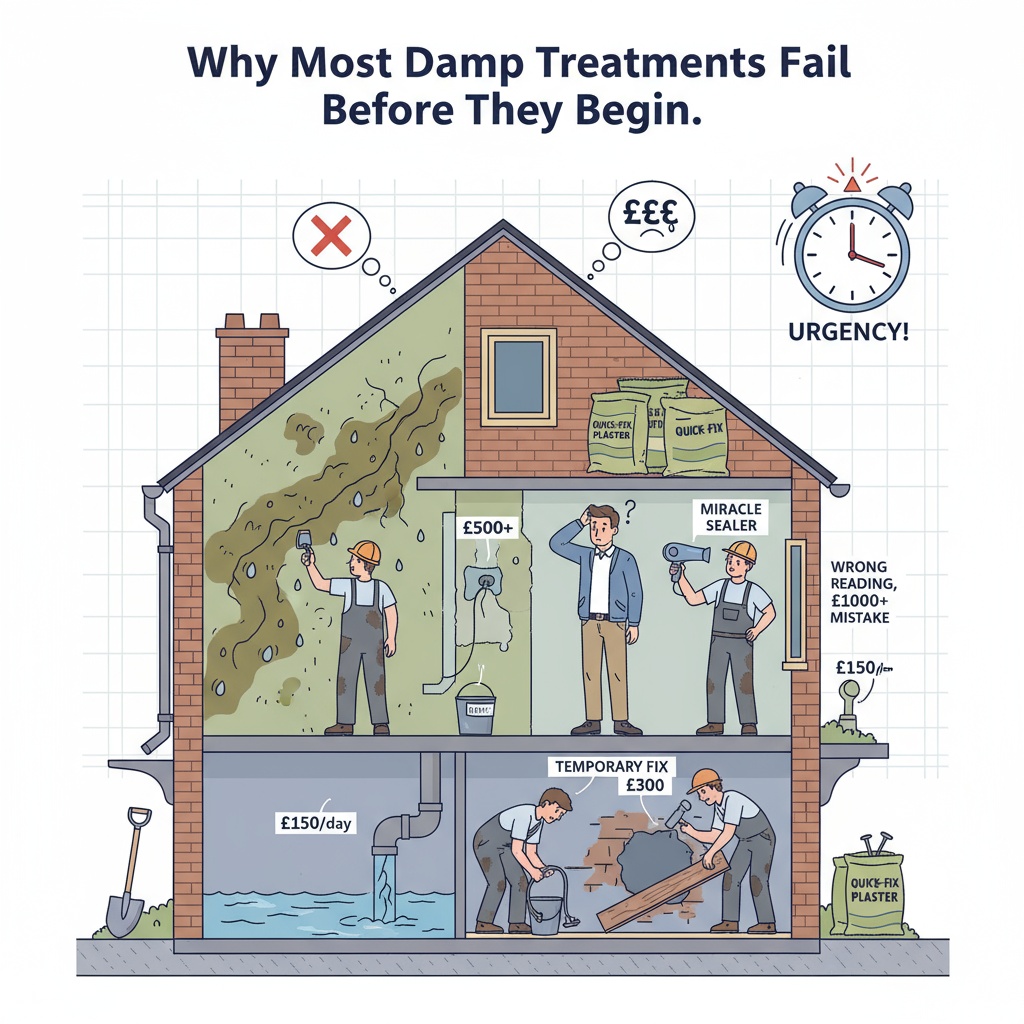
Why Most Damp Treatments Fail Before They Begin
TL;DR: Over 60% of damp treatments fail because of misdiagnosis, not poor workmanship or materials. Accurate diagnosis using modern diagnostic tools is the foundation of successful remediation.
Core Answer:
Over 60% of failed damp repairs start with misdiagnosis or DIY surface-only attempts
Only 10% of damp problems are actually rising damp, yet it remains the most commonly prescribed treatment
Visual inspection alone cannot reliably distinguish between condensation, penetrating damp, and rising damp
Evidence-based diagnosis using thermal imaging, microwave moisture metres, and capacitance testing dramatically improves success rates
What Makes Damp Diagnosis So Critical?
I've examined hundreds of failed remediation projects.
The pattern repeats with uncomfortable consistency. Property owners invest thousands in treatments that were never going to work. Why? Because the diagnosis was wrong from the start.
The problem isn't the workmanship. It isn't the materials.
It's what happened during the survey.
Think about that for a moment. The failure was baked in before a single tool touched the wall. Before any injection. Before any membrane was laid.
What this means for you: Misdiagnosis determines treatment failure before any work begins, making accurate assessment more important than treatment method or contractor expertise.
Why Does Misdiagnosis Happen So Often?
Here's what should worry you.
UK Government guidance explicitly warns that landlords should not assume they can diagnose damp problems themselves. Even experienced property professionals recognise the complexity.
Yet misdiagnosis remains endemic.
The Numbers Don't Add Up
Only 10% of damp problems are actually rising damp.
Read that again. Ten per cent.
But rising damp treatments remain one of the most commonly prescribed solutions by contractors. Therefore, 90% of properties receiving rising damp treatments may be getting the wrong solution.
The maths is staggering.
Visual Symptoms Mislead
Condensation mimics rising damp. Penetrating damp presents similar symptoms.
Visual inspection alone cannot distinguish between them reliably. Yet many surveyors rely on surface-level assessment because they follow a simple pattern:
They see moisture
They see salt deposits
They prescribe a damp-proof course
But what if the moisture comes from condensation?
What if the salts are historic, from a problem that no longer exists?
The treatment fails. The property owner pays again. The cycle continues.
What this means for you: Similar visible symptoms across different damp types make surface-level assessment unreliable without diagnostic technology. Your eyes alone will betray you.
How Commercial Pressure Compromises Diagnosis
Some surveyors pass responsibility to remedial treatment contractors.
These contractors have a commercial interest in prescribing extensive work. Let that sink in.
The Society for the Protection of Ancient Buildings notes that true rising damp is rarer than commonly perceived but regularly misdiagnosed. Over-specification becomes profitable.
This creates a systemic issue where diagnosis becomes compromised by commercial motivations. The person telling you what's wrong profits from the treatment they recommend.
See the problem?
What this means for you: Commercial incentives can drive over-prescription of expensive treatments. Independent diagnostic assessment isn't optional. It's essential.
What Does Evidence-Based Diagnosis Look Like?
Modern diagnostic technology changes everything.
These tools enable evidence-based diagnosis rather than assumption-based prescription. The difference isn't subtle. It's transformative.
Diagnostic Tools That Actually Work
Thermal imaging: Reveals temperature patterns that indicate moisture sources
Microwave moisture metres: Detect dampness without surface contact
Capacitance testing: Maps moisture distribution through walls
When diagnosis accurately identifies the moisture source, treatment can target the actual problem.
Success rates transform. Not incrementally. Dramatically.
What this means for you: Technology-enabled diagnosis replaces guesswork with measurable evidence. You move from hoping the treatment works to knowing it will.
What Should Property Owners Demand?
Before committing to any damp treatment, demand comprehensive diagnosis.
Not a quick look. Not a free survey from someone who profits from the treatment. Comprehensive diagnosis.
Ask these questions:
What diagnostic tools will be used?
Will I receive a detailed report explaining the moisture source?
Does the report address root causes, not just visible symptoms?
Is the surveyor independent from the treatment contractor?
Qualified diagnostics cost more upfront. I won't pretend otherwise.
But they prevent the expensive cycle of failed treatments and repeated work. The cheapest survey often becomes the most expensive mistake.
What this means for you: Upfront investment in comprehensive diagnosis prevents costly cycles of failed treatments. Pay more now, or pay far more later.
Frequently Asked Questions
What percentage of damp treatments fail due to misdiagnosis?
Over 60% of failed damp repairs start with misdiagnosis or DIY surface-only attempts, making it the primary cause of treatment failure.
How can I tell if my damp problem is rising damp or condensation?
You cannot reliably distinguish between them through visual inspection alone. Professional diagnosis using thermal imaging, microwave moisture metres, and capacitance testing is required because symptoms appear similar.
Why do contractors prescribe rising damp treatment so often?
Commercial incentives and reliance on visual assessment lead to over-prescription. Only 10% of damp problems are actually rising damp, yet it remains one of the most commonly prescribed treatments.
What should a proper damp survey include?
A comprehensive survey should use multiple diagnostic tools (thermal imaging, moisture metres, capacitance testing), provide a detailed written report identifying the moisture source, and explain root causes rather than just describing visible symptoms.
How much does accurate damp diagnosis cost?
Qualified diagnostic surveys cost more upfront than basic visual inspections, but they prevent expensive cycles of failed treatments. The initial investment typically saves thousands in avoided incorrect remediation work.
Can rising damp be misdiagnosed as condensation?
Yes, and the reverse is also common. Condensation is possibly the biggest cause of rising damp misdiagnosis because both conditions produce similar visual symptoms including moisture, staining, and salt deposits.
Should I use an independent surveyor or accept a free survey from a treatment company?
Independent surveyors provide more reliable diagnosis because they have no commercial interest in prescribing expensive treatments. Treatment contractors may over-specify work to increase revenue.
What happens if damp is misdiagnosed?
The prescribed treatment will fail because it addresses the wrong problem. Property owners waste money on ineffective work, the damp persists, and additional treatments become necessary, creating an expensive cycle.
Key Takeaways
Misdiagnosis causes over 60% of damp treatment failures before any remediation work begins
Only 10% of damp problems are rising damp, yet it remains the most commonly prescribed treatment
Visual inspection alone is unreliable because condensation, penetrating damp, and rising damp produce similar symptoms
Commercial incentives compromise diagnosis when surveyors work for treatment contractors
Modern diagnostic tools provide evidence-based assessment through thermal imaging, microwave moisture metres, and capacitance testing
Upfront investment in comprehensive diagnosis prevents costly cycles of failed treatments
Demand detailed reports that identify root causes, not just visible symptoms, before committing to treatment
